Incontinence care is personal—and it has an environmental footprint
For most families, the first question about urinary incontinence is compassionate and immediate: How do we keep Mum comfortable? How do we prevent embarrassment? How do we manage this at home?
But there is a second, quieter question many South Africans are beginning to ask: What happens to all the waste?
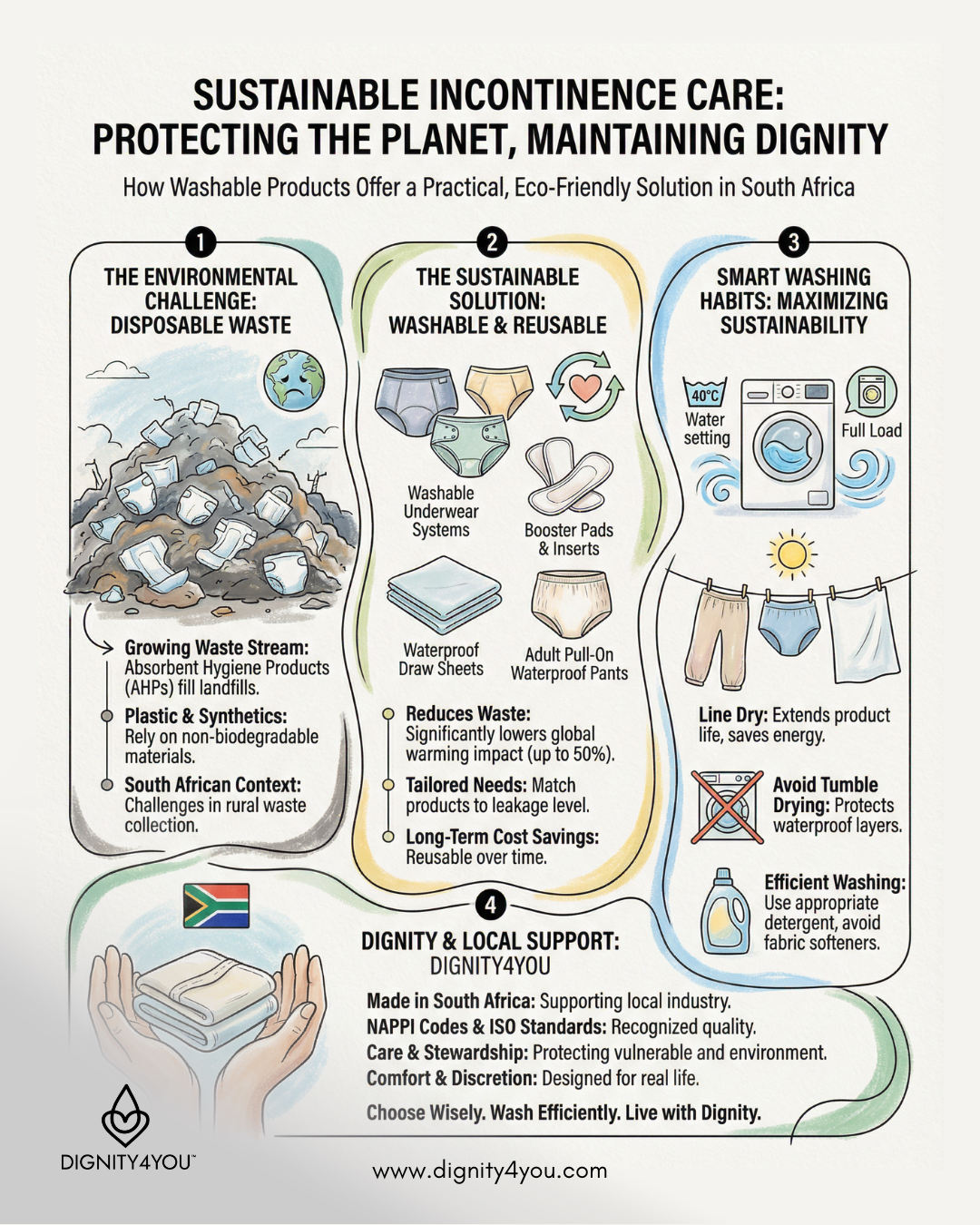
Absorbent hygiene products (AHPs)—including disposable nappies, menstrual products and disposable incontinence items—form a significant waste stream. Industry bodies describe AHPs broadly as products used to absorb human fluids such as urine and blood.
In South Africa, a national “One Health” AHP waste forum strategy highlights long-standing challenges in AHP waste management, particularly in rural, informal, and backyard dwellings, where collection systems and governance can be fragmented.
A related South African government draft strategy also notes that, despite policy supporting the waste hierarchy, much waste still ends up in landfill (and even open fields).
Against that backdrop, washable incontinence solutions are not merely a lifestyle preference—they can be part of responsible stewardship.
The environmental toll of disposables: what the evidence points to
Disposable incontinence products are designed for convenience, but they typically rely on:
- plastic backings,
- adhesives,
- synthetic absorbent materials,
- packaging and repeated transport.
Research attention has historically focused on baby nappy waste, but adult incontinence waste is increasingly recognised as a major issue. A peer-reviewed study in Waste Management modelled adult and infant AHP waste flows (in an Australian context) and concluded that adult incontinence-related AHPs are a larger and faster-growing waste issue than infant nappies.
While that modelling is not South Africa-specific, the direction of travel matters: populations are ageing globally, and continence needs rise with age. The implication is straightforward—without alternatives, AHP waste increases over time.
Do reusable incontinence products actually help—or do they just move the impact into washing?
This is the question responsible households should ask. The honest answer is: it depends on design and washing practices—and that’s why research is helpful.
An open-access life cycle assessment (LCA) case study focused on incontinence products found that a shift to a partly reusable product system had the largest potential to reduce global warming impact, reporting more than 50% reduction in global warming potential compared to a corresponding disposable product (in the scenarios examined).
The same work also highlights something practical: better matching products to users’ needs (so fewer products are used overall) can reduce environmental impacts across categories.
A more recent academic thesis (2025) also explored environmental and cost outcomes of disposable vs reusable incontinence solutions and found that tailored regimes and reusable alternatives can offer substantial environmental benefits (with feasibility varying by level of incontinence).
So yes—washables can reduce environmental impact—but only if they are used and cared for wisely.
The “use phase” matters: washing habits can make washables more sustainable
Life cycle research comparing reusable and disposable hygiene items repeatedly points to the same principle: washing is where much of the reusable footprint lives.
The LCA literature notes that home-washed reusable systems can perform well when washed efficiently (e.g., in water-efficient machines, lower temperatures, and line dried).
Dignity4You’s own practical guidance echoes this common-sense approach: wash with full loads where possible, use cold or warm water rather than always hot, and line dry where feasible.
What sustainable continence care can look like in South Africa
Sustainability is never “one perfect product.” It’s a routine that respects health, dignity, and household realities.
Here is a practical, South Africa-friendly approach:
1) Choose reusables where they fit your level of leakage
- Many adults with light-to-moderate leakage can use washable underwear systems confidently.
- Some individuals with heavier needs may still require a blend of solutions.
The goal is not purity; it is wise reduction where possible.
2) Add waterproof layers that extend the life of bedding and clothing
Waterproof layers reduce the “cascade effect” of leaks—where one incident becomes a full bedding/clothing change.
Dignity4You’s washable waterproof layers include:
- Waterproof Draw Sheet (wash at 40°C; do not tumble dry; air dry recommended)
- Adult Pull‑On Waterproof Pants (wash at 40°C; do not tumble dry; air dry recommended)
When these layers prevent frequent full changes, they can reduce overall washing volumes and help households maintain a steadier routine.
3) Wash efficiently (this protects both the planet and your budget)
Practical habits that typically reduce impact:
- wash in full loads where possible,
- use 40°C when appropriate for the garment (and per product instructions),
- avoid tumble drying waterproof items (also extends lifespan),
- line dry when possible,
- avoid fabric softeners if they reduce absorbency or damage technical fabrics (follow product instructions).
4) Keep dignity at the centre of sustainability
For those living with urinary incontinence, “sustainability” should never become a new form of pressure or shame. The moral aim is care:
- care for the person,
- care for the caregiver,
- and wise care for the environment.
For many Christians, this aligns naturally with stewardship—tending what God has entrusted to us, while protecting the vulnerable with gentleness.
How Dignity4You contributes: washable solutions made locally, designed for real life
Dignity4You positions itself as a specialist in washable and reusable urinary incontinence products, suitable for bladder leakage and stress/urge incontinence, with products made in South Africa and supported by NAPPI codes and ISO quality standards.
Their sustainability message is not abstract: it is grounded in practical steps and washable products intended for repeated use.
In a country where AHP waste management remains a known challenge, reusable options can be one household-level action that supports broader environmental aims—especially when chosen thoughtfully and washed efficiently.