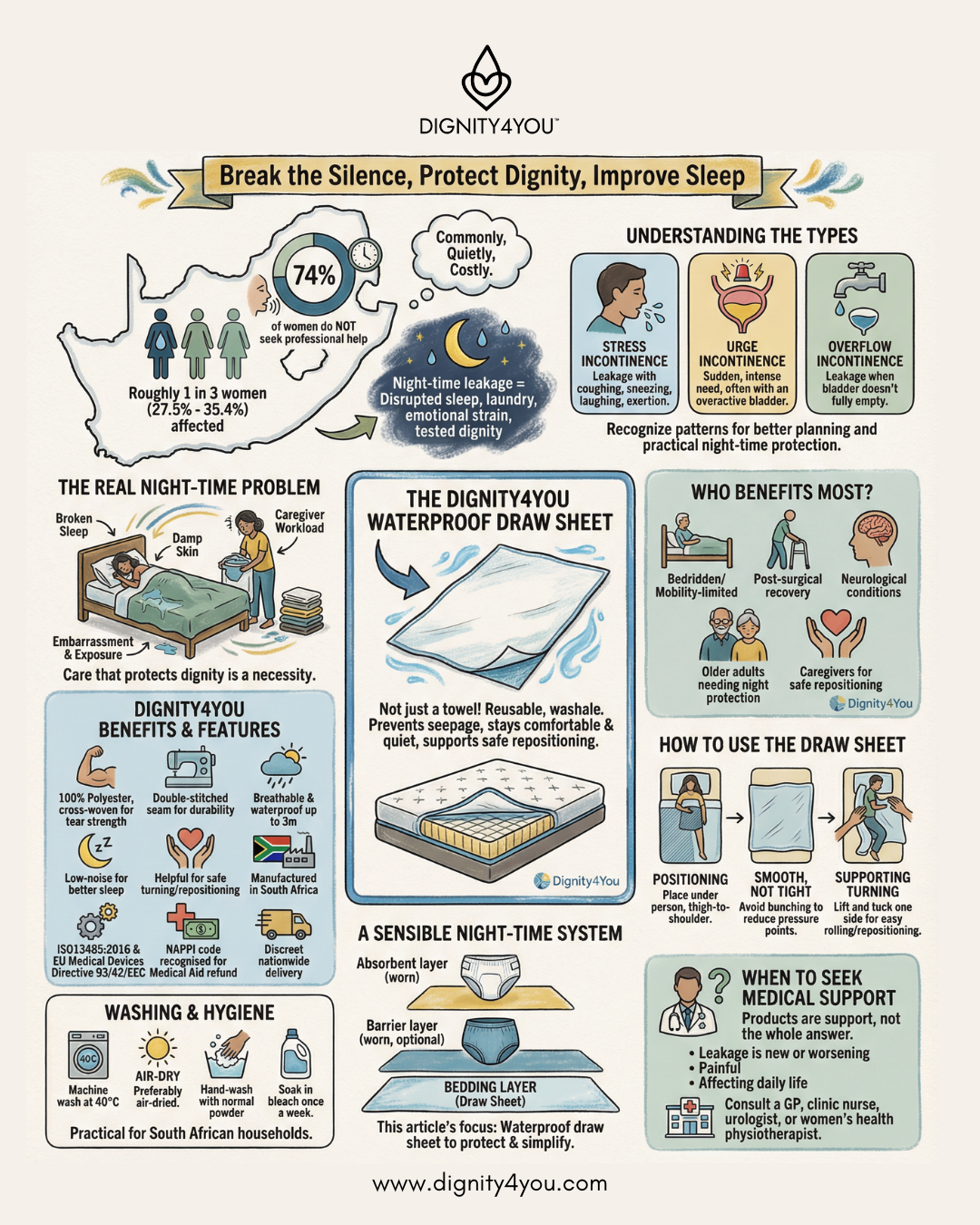
Urinary incontinence in South Africa: common, quiet, and costly in sleep
Urinary incontinence (the involuntary leakage of urine) affects many adults, yet it is still spoken about in whispers. In South Africa, research published in the South African Journal of Physiotherapy notes that urinary incontinence affects roughly one in three women, with local estimates commonly reported in the 27.5%–35.4% range.
A community study in KwaZulu-Natal reported a prevalence of about 35%, and importantly, found that only 26% of women experiencing urinary incontinence had sought professional help.
That combination—high prevalence and low help-seeking—means many households quietly carry the burden in the most practical place: the bed.
Night-time leakage is not only uncomfortable; it can disrupt sleep, increase laundry demands, and add emotional strain to caregiving. Dignity is often tested in the small hours of the morning. And that is exactly where the right protective layer can make a meaningful difference.
Understanding the types of urinary incontinence (so you can plan better)
While only a clinician can diagnose the cause, it helps to recognise patterns:
- Stress urinary incontinence: leakage with coughing, sneezing, laughing, or exertion. The International Continence Society describes it as involuntary leakage “on effort or physical exertion… or on sneezing or coughing”.
- Urge urinary incontinence: leakage after a sudden, intense need to pass urine, often linked to an overactive bladder.
- Overflow incontinence: leakage when the bladder doesn’t fully empty.
Why this matters: different patterns call for different routines. Even if medical care is still in progress, practical protection at night can reduce stress for the person living with incontinence and the caregiver supporting them.
The real night-time problem: bedding, mattresses, and repeated disruptions
Incontinence products are often discussed as “what to wear”, but night-time success is frequently about what’s underneath.
When bedding becomes wet:
- sleep is broken (sometimes repeatedly),
- skin may remain damp longer than it should,
- the caregiver’s workload grows,
- and the person living with incontinence may feel exposed, embarrassed, or burdensome.
Care that protects dignity is not a luxury; it is part of person-centred continence support.
What is a waterproof draw sheet—and why it’s different from “just putting down a towel”?
A waterproof draw sheet is a reusable, washable protective sheet placed beneath the individual—typically across the area most at risk for leakage (often thigh-to-shoulder positioning). Unlike towels or improvised layers, it is designed to:
- prevent seepage into bedding and mattresses,
- stay comfortable and quiet,
- and (crucially) support safe repositioning for those who are bedridden.
The Dignity4You Waterproof Draw Sheet: built for protection and handling support
The Dignity4You Waterproof Draw Sheet is specifically designed for bed protection and caregiver assistance. It is described as:
- 100% polyester, cross-woven for improved tear strength
- double-stitched seam for durability
- breathable and waterproof up to 3m water pressure
- low-noise (important for sleep and dignity)
- suitable to place underneath patients to protect bedding
- helpful for turning/repositioning without “manhandling”
- manufactured in South Africa
- compliant with ISO13485:2016 and the EU Medical Devices Directive 93/42/EEC
- recognised for Medical Aid refund with a unique NAPPI code
- delivered discreetly nationwide
Dignity4You also provides caregiver-focused guidance highlighting the draw sheet’s role in reducing bedding damage, easing repositioning, and simplifying care routines.
Who benefits most from a waterproof draw sheet?
This product can be especially helpful for:
- bedridden or mobility-limited adults (home care or facility care),
- post-surgical recovery where mobility is reduced,
- neurological conditions affecting bladder control or movement,
- older adults needing night-time protection,
- caregivers who must reposition a loved one safely and regularly.
How to use the draw sheet (a simple, dignified set-up)
Dignity4You’s guidance focuses on practical placement and handling:
- Positioning: place the draw sheet underneath the person, ideally thigh-to-shoulder.
- Smooth, not tight: avoid bunching to reduce pressure points.
- Pair it with the right “wearable” layer: the draw sheet is a bedding protector, not an absorbent garment.
- Turning support (for caregivers): the draw sheet can assist with rolling and repositioning by lifting and tucking one side, then reversing the action to replace it.
This approach matters because safer handling protects both the caregiver’s body and the comfort of the person being cared for.
Washing & hygiene: what Dignity4You recommends
The Dignity4You Waterproof Draw Sheet can be:
- machine washed at 40°C
- must not be tumble dried
- preferably air-dried to extend lifespan
- hand-washed with normal washing powder
- soaked in bleach once a week to prevent bacterial growth
These instructions are especially practical in many South African households where line-drying is common and energy costs encourage low-heat routines.
A sensible night-time “system” (not a single product)
Incontinence care works best when it is layered thoughtfully:
- Absorbent layer (worn): washable incontinence underwear / washable nappy options suited to the level of leakage
- Barrier layer (worn, optional): waterproof pants if needed
- Bedding layer: waterproof draw sheet to protect the bed and simplify clean-up
Dignity4You offers a range of washable and reusable incontinence products—made in South Africa, with NAPPI codes and ISO13485:2016 compliance referenced by the brand—allowing families to build a routine that fits real life.
When to seek medical support (because products are not the whole answer)
Protective products are a compassionate support—but urinary incontinence is also a health issue worth discussing with a clinician. If leakage is new, worsening, painful, or affecting daily life, a GP, clinic nurse, urologist, or women’s health physiotherapist can help assess causes and recommend treatment options. Guidance on causes and types is widely available in clinical overviews such as the NHS condition summary.