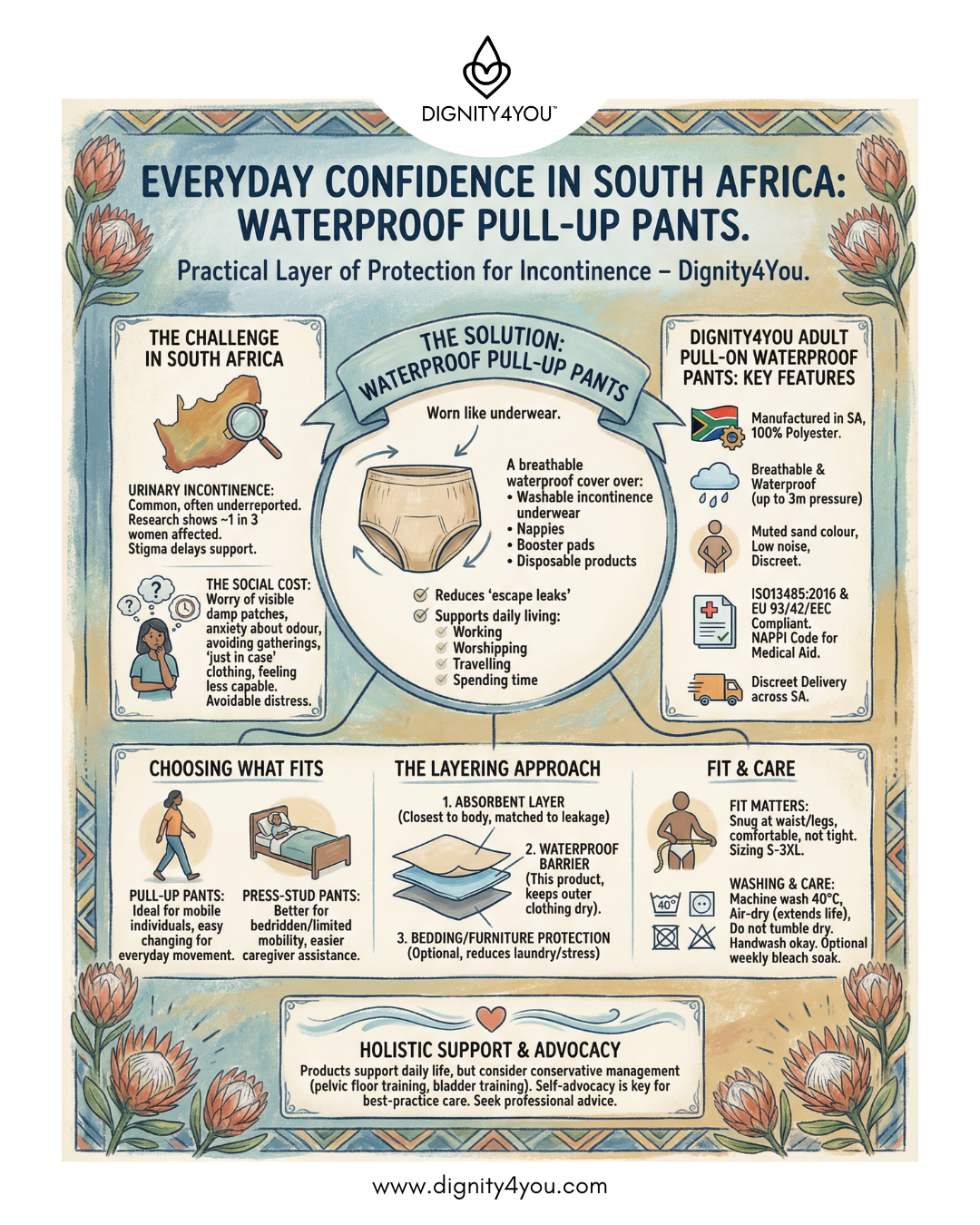
Urinary incontinence is more common than many realise—especially among women
South African research continues to show that urinary incontinence affects a significant portion of adult women (often cited around one in three).
And because stigma is real, many people delay seeking support; the KwaZulu-Natal study found only about a quarter of women with symptoms had consulted a professional.
This is why practical solutions matter: not as a substitute for medical care, but as a way to keep living—working, worshipping, travelling, and spending time with loved ones—without constant fear of leaks.
Why “leak protection” is about more than dryness
For adults, the most difficult part of urinary incontinence is often the social cost:
- the worry of visible damp patches,
- anxiety about odour,
- avoiding gatherings or church services,
- keeping spare clothing “just in case”,
- and the quiet grief of feeling less capable than before.
Dignity-centred care means reducing avoidable distress. And one of the simplest ways to do that is to add a reliable waterproof barrier layer over an absorbent garment.
What are waterproof pull‑up pants (sometimes called pilchers)?
Waterproof pull‑up pants are worn like ordinary underwear—pulled up and down as needed—but designed to act as a breathable waterproof cover over:
- washable incontinence underwear,
- washable nappies,
- booster pads,
- or even commercial disposable incontinence products.
They help reduce “escape leaks” that can dampen clothing and bedding—especially when you move, sit, stand, or get out of a car.
The Dignity4You Adult Pull‑On Waterproof Pants: key features (and why they matter)
Dignity4You describes their Adult Pull‑On Waterproof Pants as:
- manufactured in South Africa from 100% polyester
- breathable and waterproof up to 3m water pressure
- can be worn as extra protection over Dignity4You products or commercial incontinence products
- muted sand colour to suit wearing under clothing
- low noise factor (more discreet and comfortable)
- compliant with ISO13485:2016 and the EU Medical Devices Directive 93/42/EEC
- recognised for Medical Aid refund with a unique NAPPI code
- delivered discreetly across South Africa
For many adults, these details aren’t “nice to have”—they are the difference between leaving home calmly and staying home out of fear.
Pull‑up pants vs press‑stud waterproof pants: choosing what fits your life
- Pull‑up waterproof pants are ideal when the person is mobile and can manage changing with minimal assistance. They work well for everyday movement, errands, and normal toileting routines.
- For someone who is bedridden, caregiver-fastened options may be easier (because undressing is different when mobility is limited).
A good continence plan adapts as needs change—without shame.
The “layering” approach: a simple way to reduce leaks
Think of incontinence support in layers:
- Absorbent layer (closest to the body)
Choose a product matched to your level of leakage (light, moderate, heavier). Medical advice can help, but practical trial and adjustment often matters too. - Waterproof barrier layer
Pull‑up waterproof pants go over the absorbent garment to help keep outer clothing dry. - Bedding/furniture protection (optional but wise)
Especially for night-time or rest periods, waterproof bedding protection reduces laundry and stress.
Dignity4You’s product range is built around washable, reusable layers, made locally and supported by NAPPI codes for many items.
Fit matters: comfort is part of dignity
Dignity4You provides sizing options (S–3XL) and notes that, when correctly sized, the fit should be snug and comfortable to support minimal leakage.
Practical fit tips (non-medical):
- snug at waist and legs helps prevent gaps,
- not so tight that it marks skin or causes rubbing,
- if between sizes, consider how you’ll wear the absorbent layer underneath (bulk changes sizing needs).
Washing & care: a realistic routine for South African homes
Dignity4You’s instructions include:
- machine wash at 40°C
- do not tumble dry
- air-dry to extend the life of the waterproof material
- handwash with normal washing powder if needed
- optional weekly bleach soak to reduce bacterial growth
This routine suits many South African households where line-drying is normal and electricity costs make low-heat care sensible.
A gentle word about pelvic floor support (and why products and treatment belong together)
Incontinence products support daily life—but many people also benefit from conservative management such as pelvic floor muscle training or bladder training, depending on the type of incontinence. Clinical resources commonly describe pelvic floor weakness as a contributor to stress incontinence and identify bladder overactivity as a driver of urge incontinence.
South African research also highlights that primary-care management doesn’t always align with best-practice guidelines, and referral pathways can be limited—another reason self-advocacy matters.